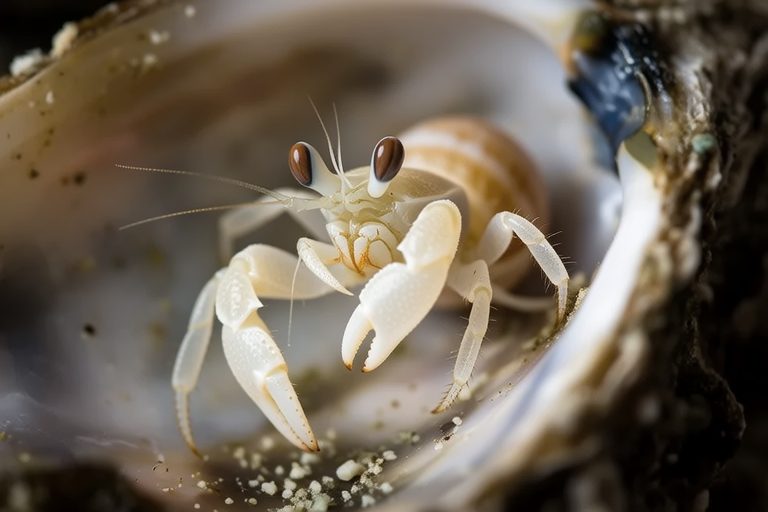
The Enigmatic World of Pea Crabs: Tiny Titans of the Sea
Welcome to the captivating realm of pea crabs, a group of crustaceans that have long intrigued marine biologists and nature enthusiasts alike. These diminutive creatures, despite their small stature, play a significant role in their ecosystem and have developed fascinating adaptations to thrive in their chosen habitats. Let’s embark on a journey to explore the unique characteristics, habitats, and ecological roles of these remarkable crustaceans.
Pea Crabs: The Microscopic Marvels
Pea crabs, belonging to the family Pinnotheridae, are some of the smallest crabs in the world, typically measuring less than half an inch in length. Their petite size is part of their charm and a critical aspect of their survival strategy. These crabs are often mistaken for mere specks floating in the water, but they are far from inconspicuous in their specialized niche within the marine environment. Their diminutive size allows them to navigate through the intricate channels and spaces within their host organisms, primarily bivalves like clams, oysters, and mussels.
Habitats and Ecological Roles
Pea crabs are predominantly found in coastal waters around the globe, thriving in environments where their hosts, the bivalves, are abundant. They can be found in shallow waters, estuaries, and even in deeper waters, depending on the specific species and their host preferences. Their ability to adapt to various salinity levels and temperatures makes them resilient in diverse aquatic ecosystems. In these habitats, pea crabs serve as important indicators of environmental health. Their presence or absence can reflect changes in water quality and biodiversity, making them valuable subjects for ecological studies.
Ecologically, pea crabs play a crucial role in nutrient cycling and energy transfer within their ecosystems. As parasites of bivalves, they contribute to the breakdown of organic matter and the recycling of nutrients. Their interactions with their hosts also influence the growth and reproduction of the bivalves, sometimes leading to reduced fitness but also potentially stimulating faster growth rates under certain conditions.
Symbiotic Relationships with Bivalves
The most striking feature of pea crabs is their symbiotic relationship with bivalves. This mutualistic association is one of the most profound examples of interspecies cooperation in the animal kingdom. Pea crabs live inside the shells of their hosts, benefiting from the protection and nourishment provided by the bivalves. In return, the crabs help their hosts by cleaning out debris and potentially enhancing filter feeding efficiency. This partnership is so well-established that pea crabs are often found in pairs within the same host, ensuring both males and females are present to continue the cycle.
The relationship between pea crabs and their hosts is a delicate balance. While the crabs rely on the bivalves for shelter and food, they must avoid causing too much harm to their hosts. This fine line is maintained through the crabs’ feeding habits and reproductive strategies. Pea crabs feed on the host’s tissues and fluids, but their impact is generally minimal, allowing the bivalve to continue its normal life cycle.
Recent Scientific Discoveries
Recent research has shed new light on the behavior and biology of pea crabs, revealing surprising aspects of their lives. Scientists have discovered that pea crabs exhibit complex mating behaviors, including elaborate courtship rituals and selective mate choice. These behaviors suggest a level of cognitive complexity not previously attributed to such small animals. Additionally, studies have shown that pea crabs can influence the genetic diversity of their host populations, potentially contributing to the evolution of bivalve species.
One of the most exciting findings is the discovery of chemical communication between pea crabs and their hosts. Researchers have identified specific compounds released by the crabs that may signal to the bivalves, facilitating the establishment of the symbiotic relationship. This chemical signaling could explain why some bivalves are more likely to host pea crabs than others.
Adaptations and Challenges
Pea crabs have evolved several adaptations to thrive in their challenging environment. Their small size allows them to fit into tight spaces within the bivalves’ shells, providing protection from predators and harsh environmental conditions. Their flattened bodies enable them to move efficiently within the narrow confines of their hosts, while their long legs and claws allow them to reach food sources and navigate their surroundings.
Despite these adaptations, pea crabs face numerous challenges in their ecosystem. Climate change, pollution, and overfishing pose significant threats to their survival. Changes in water temperature and acidity can disrupt the delicate balance of their symbiotic relationship with bivalves, potentially leading to population declines. Additionally, the introduction of non-native species can outcompete native pea crabs for resources, further jeopardizing their existence.
Efforts are underway to protect pea crabs and their habitats. Conservationists are working to establish marine protected areas and promote sustainable fishing practices to ensure the continued survival of these tiny titans. Public awareness campaigns are also being launched to educate people about the importance of pea crabs and the need to preserve their ecosystems.
The Fascinating Life Cycle of Pea Crabs
The life cycle of pea crabs is as intricate as it is fascinating. After hatching from eggs attached to the female’s abdomen, the larvae spend a few weeks drifting in the plankton before settling on a suitable host. Once attached, the larvae undergo metamorphosis, transforming into juvenile crabs that will eventually mature into adults. The entire process is a testament to the resilience and adaptability of these tiny creatures.
The lifespan of pea crabs varies depending on the species and environmental conditions. Some species can live for several years, while others may only survive for a single breeding season. Despite their short lifespans, pea crabs are highly efficient at reproducing, ensuring the continuation of their species.
Conclusion
In conclusion, pea crabs are more than just tiny inhabitants of the sea; they are vital components of marine ecosystems, playing a crucial role in nutrient cycling and energy transfer. Their symbiotic relationship with bivalves is a marvel of evolutionary adaptation, showcasing the intricate web of life that exists beneath the waves. Recent scientific discoveries have deepened our understanding of these fascinating creatures, revealing unexpected complexities in their behavior and biology. As we continue to explore the mysteries of the ocean, pea crabs remain a source of wonder and inspiration, reminding us of the incredible diversity of life on Earth.
